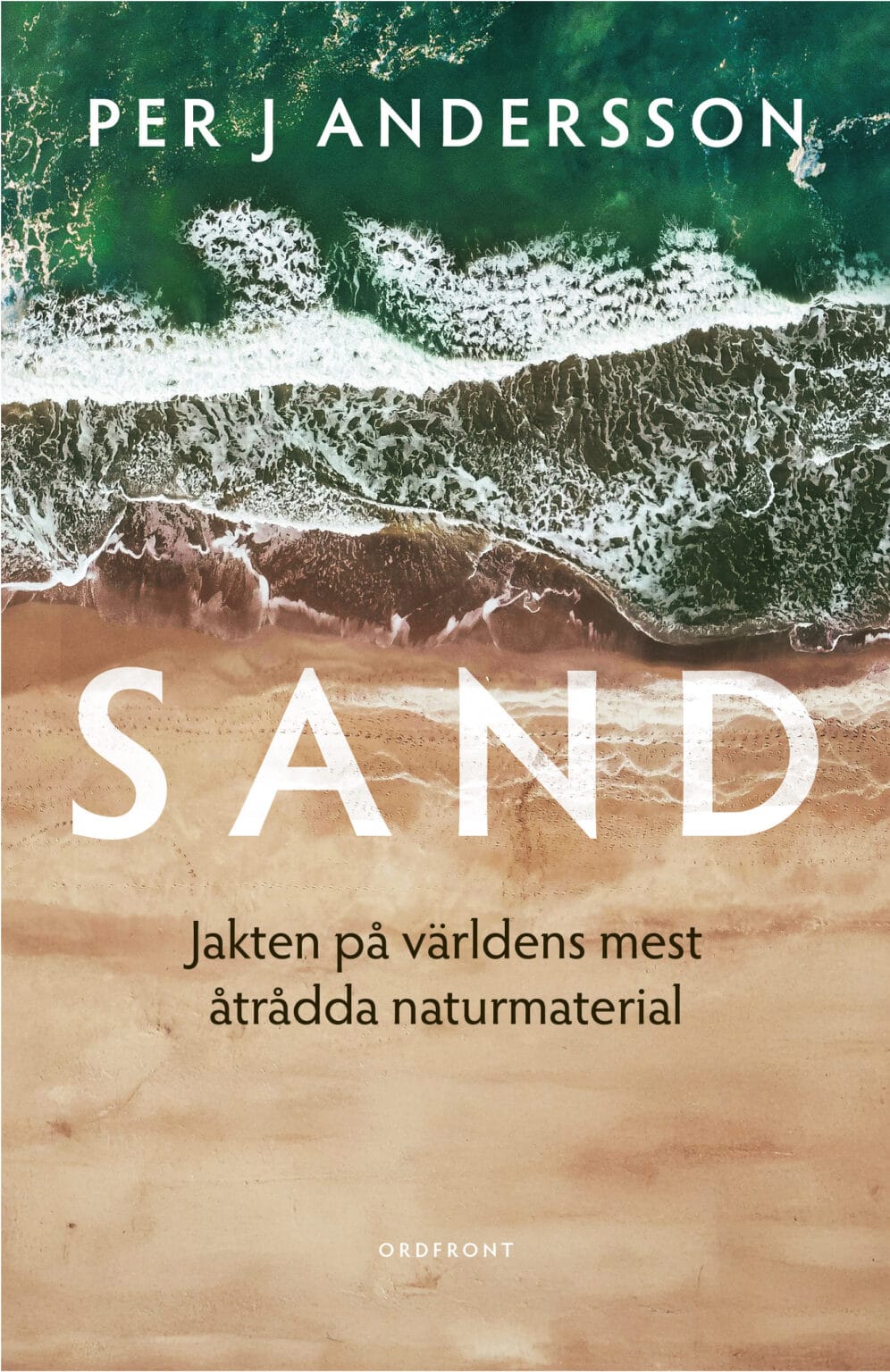
A pitch and a chapter synopsis of my latest book, published in August 2025 in Swedish with the title: Sand – Jakten på råvaran som formar vår värld (Ordfront 2025).

Interested in buying the rights, contact my agent Paul Sebes at Sebes & Bisseling Literary Agency.
Pitch
What does the house you live in have in common with the glass you drink from, the cell phone you call from and the computer you work on?
The answer is: Sand.
Sand is the world’s most widely used natural resource and is extracted in even greater quantities than fossil fuels. Up to 50 billion tons are dug up annually to build the modern world we take for granted. In China alone, more sand recently was used in four years to feed the country’s construction boom than the US used in the entire 20th century.
Sand is in the concrete of your house walls, the asphalt your car drives on, the windows you look out at the city through, the microchips that are the skeleton of all digital devices and are used to cast steel, purify drinking water and make paint, medicine tablets, cosmetics and toothpaste.
Sand is created by wearing down rocks and transporting them in streams and rivers to the sea. But this process takes millions of years. Today, humans are digging up more sand than is being created naturally. Soon, the world will run out of sand.
How can this be possible? Surely there’s enough in the deserts to last and be left over? Yes, but that sand is largely useless for human purposes. The desert sand is too smooth to be useful, it doesn’t stick together. Most of the angular sand that is suitable for industry comes from rivers, lakes and seas.
Around the world, rivers, deltas, lakes and beaches are being dug up to keep the construction boom going. Three billion people living near water are affected by an increased risk of flooding. At the same time, the biodiversity of many species is being destroyed.
In many countries, extraction is unregulated. In others, the laws that do exist are ignored. There is a lot of money to be made from supplying the construction industry with sand. Criminal sand mining is taking place in around 70 countries. India and Kenya are currently plagued by the sand mafia, which has killed hundreds of journalists, police officers and activists who opposed the exploitation.
Per J Andersson’s new book Vanishing sands – the beaches that disappeared is about the threat to our sandy beaches, but also about man’s relationship with coasts, beaches and ultimately sand, a relationship that was founded shortly after pre-humans climbed down from the trees and made their way via the savannah to the coast.
In this book, he explores everything from life in the desert and the cultural history of sand to the world’s sandiest sport (beach volleyball), the history of the sandbox and the art of sand sculpture. He also talks about how we could construct a world that doesn’t require us to dig up the world’s beaches, rivers and lakes. In addition, he takes us back in history to find out why the sandy beach, preferably one with white sand lined with coconut trees, today is so strongly associated with our idea of a paradise.
Chapter synopsis
1. A referral to a sandy beach
The author’s personal story of how a diagnosis of psoriasis at the age of six led to a referral for treatment on a sunny sandy beach. There he learned to love the beach in general and the sand in particular, which has shaped his life ever since.
2. No sand, no Silicon Valley
But the beloved sandy beach is threatened by our rapidly growing modern urban world. Without sand, we wouldn’t be able to build houses made out of concrete and glass, make tiles, porcelain, asphalt, car tires, paint alloys – or microchips for computers. In other words, without silica sand there would be no digital world. Nor would we be able to make toothpaste, cosmetics, medicine tablets or to cast steel, drill for oil and purify drinking water. Three quarters of the world’s sandy beaches are disappearing because of the extraction of the sand used to make all these products, especially concrete and asphalt. But why not use desert sand? The answer is: If not useless for human purposes, almost useless. A concrete block made from desert sand grains will have about half the strength of the right kind of sand. The main reason is that the desert sand grains have been ground too round by the winds. The sand that humans need for filtration and concrete should consist of slightly more angular grains. Only five percent of the world’s sand is usable for human purposes.
3. Our cities are built of sand
In ancient Rome, concrete was used to build, but then it was forgotten until it was reinvented in the 19th century. Since the end of the Second World War, it is by far the most common building material in the world. Concrete is 75% sand. Building houses in concrete therefore requires enormous quantities of sand. Today, humans dig up 50 billion tons of sand a year. This is more than the annual natural supply of sand from streams, creeks and rivers. The sand we extract and transform into different materials weighs a hundred times more than all the forests cut downed in the same period. All the sand extracted annually in the world is enough to build a wall twenty-seven meters high and twenty-seven meters wide around the Earth’s equator. Half of the world’s concrete is poured in China. In the four years between 2011 and 2014, the country’s construction industry used more sand than the United States used in the entire 20th century. The consequence: an ecological disaster.
4. The Indian sand mafia
Meet Sumaira Abdulali in Mumbai, who is fighting to stop the Indian sand mafia, an unholy alliance between sand mining companies, corrupt police and local politicians. Illegal sand miners have tried to kill her twice, but she continues her fight. In India, sand has also become a way for poor villagers to make extra money from urbanization and the construction boom. The sand they dig up from the rivers means that those who live on fishing can no longer make a living. As a sideline, they also start digging up sand to sell. As a result, the fish population is dwindling and soon there will be no return for those who used to make a living from fishing. In the state of Maharashtra alone, where the fast-growing megacity of Mumbai is the capital, 80 000 fishermen have changed their livelihoods and become sand diggers. Those who don’t, or find other livelihoods, are moving to the big city. This in turn means that cities are growing even faster, and even more sand is needed to make more concrete to build even more houses and roads.
5. Homo sapiens was born on a sandy beach
In the early 1960s, American geographer Carl Sauer was one of the first to point out that humans moved to the coasts earlier than previously thought. Why did we do this? Because that’s where the two ecosystems of land and sea meet to form an overlapping border zone, an ecotone. An environment with mixed vegetation types and a richness and abundance of species that is difficult to match on the savannah. On the beaches, shellfish were abundant and have played a particularly important role in how humans became human. The explanation is the fatty acids, especially polyunsaturated omega-3, which are abundant in aquatic animals, and which caused our brains to start growing to the proportions they are today. Only when we supplemented the grilled buffalo, antelope and impala deer with seafood – what today’s restaurant menus call surf and turf – did we become the specie we are today. The Judeo-Christian creation story’s idea of paradise as an inland garden has for thousands of years distorted the West’s view of human origins. For a long time, we lived unaware of what happened in the waves, as the shore is constantly transformed and washed over; the traces have simply been washed away. In fact, paradise was a sandy beach.
6. A packet full of sunshine
After generations of seeing the sea as threatening and the beach as inhospitable, something happened in the late 18th century. The rise of industrialism created a sense of confinement in the growing cities and a longing for the wide-open spaces and fresh air of the coast. The Enlightenment did away with the monsters, while the Romantic artists and poets championed the sublime seaside experience, inspiring better-off Europeans to head for the coasts. The image of the beach began to change. But it took more than 100 years for sea bathing and sunbathing on sandy beaches to become popular. Then things moved quickly. The white sandy beach lined with palm trees is the most desirable. Since the American middle class discovered Hawaii’s beaches after the Second World War, there has been a “Polynesianization” of the world’s beach culture. Today, there is a universal allure to landing, like Robinson Crusoe, on a tropical beach that no one else has walked on, where your footsteps will be the first. But mass tourism has made it increasingly difficult to find such a beach, as more and more beaches around the world are occupied by mass tourism and privatized to the exclusion of local people. Beaches that are paradise for some can also be hell for others. Beaches have recently become a symbol of the refugee crisis, with the floating bodies of drowned refugees.
7. The art of selling sand in the desert
The United Arab Emirates is largely desert. Yet it imports sand. The construction of the world’s tallest building alone, the 828-metre Burj Khalifa skyscraper, consumed 103 000 square meters of glass and 330 million litres of concrete, and therefore several million tons of sand. Add to that the world’s largest man-made islands – Palm Jumeirah and Palm Jebel Ali – built from sand. The sand for the construction boom is being taken from the seabed just off the coast and from a completely different part of the world, including Australia. The bunker sand for the emirate’s world-class golf courses isn’t local either, shipped in from North Carolina and Ontario, more than ten thousand kilometres away. So, selling sand to the desert has proved very successful. The projects to create artificial sand island worlds have had a major impact on the marine biodiversity of the Gulf. The seawater has become cloudy and less attractive not only to tourists, but also to fish, crustaceans, corals and oyster beds.
8. Sand play for rich and poor
Inspired by the ideas of the educationalist Friedrich Fröbel, sand piles for children’s play began to be laid out in Berlin’s parks in 1850. Sandboxes were then built in the courtyards of the city’s kindergartens. American doctor Marie Elizabeth Zakrzewska travelled to Berlin, saw the sandpiles in the parks and brought the idea home. In the 1880s, the first sand gardens appeared in Boston and soon in Chicago and New York. They were usually established in neighbourhoods with many newly arrived immigrants. The idea was that sand play would help poor children catch up with the better-off in creative and motor development. On the German North Sea and Baltic Sea beaches, a tradition was soon born among adult bathing tourists to build large sandcastles to ring in their bath towel and picnic basket. But the privatization of public space, which the construction of the sandcastles entailed, led to conflicts. German tourists visiting beaches in neighbouring countries often put up the country’s flag on their castles. On beaches in both Denmark and the Netherlands, which had recently been occupied by Germany, the local population protested. The German tourists did not understand the emotions they were stirring up with their sand constructions. When, in the dark of night, local youth gangs trampled them until nothing remained, they realised.
9. The journey of the grain of sand from the mountain to the sea
The story of the grain of sand is about both liberation and reunification. Liberation starts with the rock cracking. After a hundred years, millennium or a million years, the rock breaks into smaller pieces that slowly but surely turn into sand. In time, the sand is compressed and reverts to rock before being released once again and turning into sand. The grain of sand that sticks to your little finger may have gone through six such cycles since the Earth was formed, each of which took 200 million years. Sand is man’s favorite analogy when it comes to both unpredictability and unimaginable quantities. The Bible is full of sand and poets write and artists sing about sand – like William Blake who picked up a grain of sand and saw in his hand “infinity and eternity” and Bob Dylan who sang: “In every grain of sand”. But there are not an infinite number of grains. A University of Hawaii physics professor found that there are 7 quintillion 500 quadrillion grains of sand, which is the same as 7.5 billion billion – give or take a trillion. Sand fascinates many people to the point that they collect it. The International Sand Collector’s Society attracts new members with the slogan Exploring the world grain by grain. There are so many varieties to collect: sand can be light brown, white, red, black and even green. To protect sand from the growing number of sand collectors, some countries threaten fines and even imprisonment for those who take sand out of the country.
10. With your sand we will build our city
The country that imports the most sand in the world is the small Southeast Asian city-state of Singapore. To make room for expansion, it has increased its land area by 22% since independence 50 years ago. And it has done so with imported sand from neighbouring countries in the region. As a result, Malaysian beaches have been destroyed, fishing in Cambodia’s rivers has declined, rice crops in the Mekong River delta have been destroyed and entire Indonesian islands have sunk. One rises from the sea; the other is flooded by it. Could the saying ‘one man’s bread is another man’s death’ be any clearer? Even in Lagos, Nigeria, sand is being dug out of the sea to expand the city, leading to flooding. And in the Spratly Islands in the South China Sea, rich in fish (10% of the world’s fish stocks are believed to be found here) and supposed oil and gas deposits, China has built three artificial islands on top of a now-destroyed underwater reef. Beijing has sent an armada of ships with some of the world’s largest and most advanced dredging machines whose sand extraction has been called “the fastest permanent extinction of coral reefs in human history”.
11. In the sand they build what you dream of
A visit to an international sand sculpture competition on the Swedish east coast and meetings with creative sand artists from around the world. They have chosen to create in a material that allows the artwork to exist for only a short time. A sculpture lasts for days, maybe weeks, at best months, before it crumbles. Perishability, as in a Buddhist mandala, is the best thing about sculpting in sand, according to sand artists, who, like the Tibetan Buddhist monks, enjoy destruction as much as creation. In addition to symbolizing impermanence, sand has played a central role in European folklore, where the Sandman sprinkles sand in the eyes of children to make them fall asleep and dream sweet dreams. Another version of the Sandman appears in the American superhero stories from Marvel Comics, where he lives in the Land of Dreams in the Faerie Kingdom in Neverland, where he is the main responsible for sleep and dreams. In E T A Hoffmann’s 1816 short story, the Sandman throws sand into children’s faces so that their eyes pop out. In the hard rock band Metallica’s Enter Sandman, he throws sand into children’s eyes, causing them to have nightmares.
12. The world’s sandiest sport
Beach volleyball took shape in the 1920s on the beaches of California among surfers waiting for the right wave height. Bored, they picked up a ball and started throwing it to each other. The sport spread first to Hawaii, then to Brazil before moving on to the rest of the world. Often hand in hand with surfing. After all, the two activities share a philosophy and art of living that is based on not thinking about yesterday and tomorrow, but that the most important thing is the sense of here and now. The 1996 Atlanta Olympics was the first time that the sport was incorporated into the Olympic community, but the players complained that the sand was too hard. So, after the Games, a standard was agreed. The grains of sand should be small (no larger than one millimetre), dust-free, self-draining, round in shape and clean so that they don’t pack together even after a sudden downpour. The demand for the right kind of sand can cause organizers of international competitions to transport sand thousands of kilometres. It is not only beach volleyball courts that require the right kind of sand from distant dunes. In 2014, the United Arab Emirates imported more than $5 billion worth of sand and gravel to build racecourses for competing thoroughbred horses. That year, 1,500 cubic meters of sand from a German sandpit were sent to the Dubai World Cup racecourse. In 2003, a British sand extraction company was commissioned to ship 3 000 tons of sand from Lancashire to Dubai. And Hawaii has imported sand from both Australia and China to build golf courses.
13. On safari in a desert full of life
“Haaa, moooaaa!” The call sets the camels in motion. They unfold their well-folded legs, lift their snake-like, spotted necks to the sun and grunt irritably. A muffled, trapped abyssal gurgle, as if the roar is stuck deep in the stomach, a fairy tale sound. At last, the caravan is on its way. Once again, I ride the grinding, rocking stride of the pass over an ever-changing desert landscape. Red, rocky shale plains. Sandy, dry creek beds. Light brown cracked earth. Decimetre-high monsoon grass with downy tufts that shimmer like silver in the flat afternoon sun. Soft, ridged dunes dotted with rustling bushes and rolling steppe runners, moving west like the wind, animals and people. The definition of a desert is an area of land with low rainfall, high evaporation and little vegetation. This does not mean that it is lifeless. I am on a camel safari in the Indian Thar Desert, which is full of wildlife and vegetation that has adapted to the low-rainfall conditions. Animals and plants living here must withstand both high and low temperatures and cope with little and uneven access to water. On an evening in the desert, I think about how the desert areas of the world have been built with mud for thousands of years – very fine sand mixed with water. In Burkina Faso, architects are once again looking to build new, large and modern buildings with clay, a traditional building material, because it is better than concrete at naturally creating cool indoor spaces. While concrete easy heat through, leading to hot, stuffy rooms, thick clay walls absorb heat during the day and release it at night, nature’s own air conditioning, working well off-grid.
14. The ever-eroding beach
The beach – the dividing line between land and sea – defies human perceptions of what constitutes a boundary. We think of a clear and firm dividing line. But in fact, the beach is very much unfixed, fluid and permeable. But it’s as if we refuse to realize it. Even a pristine beach erodes, but it is also replenished by sand from both the sea and rivers flowing towards the coast from the mountains inland. It’s a cycle where seasonal waves and winds cause the beach to shrink and expand, and the beaches are constantly replenished with new sand. To emphasize that the beach is not static but in constant motion, albeit slowly, geologists usually liken it to “a river of sand” that is constantly on its way somewhere else. Taking the long view the beach will one day dissolve, the grains of sand will disperse and reappear in a new constellation in a different place. But due to human impact, the beaches are now threatened by erosion at a much faster rate. With climate change comes more intense storms which leads to faster eroding beaches. Beaches also erode more rapid if humans build houses and other hard structures right next to the shore or build river dams that cut off the natural supply of sand from the mountains. For these reasons, the US Geological Survey fears that two-thirds of all beaches in southern California could be gone by 2100.
15. Those trying to stop overexploitation
Fifteen years ago, hardly anyone cared about sand mining. There were few studies, books and newspaper articles on the effects of extraction. Even within the scientific community, the problem of reckless sand extraction was only recently recognized. Now, the United Nations Environment Program (UNEP) has finally woken up and produced several reports and the Marine Sand Watch digital platform. Thanks to the signals sent by ships, satellites and artificial intelligence can be used to see their movement patterns and reveal whether they are dredging for sand or not. The information is free and available to all. The hope is that more governments will take notice of the scale of offshore extraction and recognize it as an environmental problem.
16. The battle for sand in Africa
At a UN meeting in Dakar, Senegal, in 2022, delegates from every African country reported problems with the degradation of sandy bottoms and beaches in rivers and lakes and along ocean coasts. As in India, it’s not just big companies that are digging up the sand. For local people in villages, the sand has become a way to supplement the small income from agriculture. And if you can earn more from digging up the field, lake or seashore than from farming and fishing, then of course you do. In Zimbabwe, Chinese companies are sucking up sand from the country’s shores, causing devastating floods. The same is true of Lake Victoria in Uganda. In Morocco, sandy beaches are being dug up to make concrete to build hotels for tourists to stay in. If things go badly, the hotel they stay in has eaten up the sand on the beach they swim from. In West Africa, there is also a conflict between tourism and sand extraction. In Sierra Leone, the beautiful sandy beaches raised hopes after the civil war that tourism could be developed to create jobs and wealth. Instead, it and many other beaches have been dug up. Trucks have been shuttling ballast to the construction industry.
17. How to build without sand
It is not realistic to stop building with concrete altogether. But perhaps we can make concrete without natural sand and start building large office and residential buildings from other materials again? Over the past decade, several Swedish towns, as well as Bergen, Berlin, London and other cities, have enthusiastically built tall, large and lavish buildings using organic building materials. In Stockholm, Wood City is currently under construction and will be the world’s largest urban wood development. But is building in wood more climate-friendly than building in concrete? You save sand with wooden houses, but what about carbon emissions? Scientists disagree, it’s all about how the houses are built. But concrete doesn’t have to mean digging up natural sand deposits either. In many countries, including Japan and Sweden, they crush rock to make aggregate instead. Other sand-saving initiatives can be found in Australia, which has the world’s largest reserve of natural sand, where slag products from the steel industry are mixed with sand to make concrete. Indonesia and the Netherlands have built car and bike paths from recycled plastic. And two major beer breweries have produced machines to instantly turn beer bottles into sand, the material it was made from.
18. Seeing the biggest in the smallest
Humans were born on an East African beach and then set off to occupy the rest of the world. Much to the dismay of the other species, we can see this more than 100 000 years later. Wild vertebrate populations are declining rapidly. The fact that we need to use natural resources to create wealth is not the problem. It’s because we do it on such a large scale and so quickly that nature can’t keep up. For many people, beaches are a place of existential reflection. The German writer W G Sebald said that after the surrender of Nazi Germany, his countrymen developed a deep fondness for beaches. There, the guilt-ridden world – the traumatic past – is left behind and the liberating emptiness – the innocent future – is in front of you. At the same time, the sea offers hope. When you look out into nothingness, you are momentarily filled with a sense of lightness. This is another reason why beaches are seen by so many as a place where, for a moment, you can turn your back on all of life’s problems and instead fish, pick shells, collect mussels, read a book, nap in the shade of a tree, have a drink, build sandcastles, play beach volleyball and beach tennis, throw a Frisbee, jog, walk, watch the sunset, kayak, canoe and SUP, and surf, swim and snorkel. I’ve learned that if nothing is done to limit large-scale sand mining, children around the world will find it harder to find a beach to build their sandcastles on. And additionally, I have learned that in every single grain of sand that fits on a beach I can see the story of something of which there is only one: planet Earth.
Interested in acquiring the rights to the book, contact my agent Paul Sebes.
 Resereportage jorden runt